 +86-0510-86219899


 English
 English
 русский
 Español


Content
- 1 What Defines an Outdoor-Grade LED Flood Light?
- 2 Beam Angle and Mounting Height: Matching the Light to the Zone
- 3 IP and IK Ratings: What Protection Level Do Outdoor Areas Require?
- 4 Heat Dissipation and Driver Life: Hidden Variables Behind 50,000 Hours
- 5 Wattage and Energy Savings: What Is the Payback for LED Flood Lights?
- 6 How to Choose an LED Flood Light for Outdoor Areas: Site by Site
- 7 Installation Guide: Common Mistakes That Shorten Flood Light Life
- 8 Frequently Asked Questions
This guide is written for facility managers, electrical contractors, and distributors who evaluate supplier datasheets rather than retail product pages. Chinese manufacturers such as Jiangsu Dingrui Lighting Technology Co., Ltd. publish the type of photometric data used in the tables below, so every parameter here can be verified before a purchase order is issued.
What Defines an Outdoor-Grade LED Flood Light?
An outdoor-grade LED flood light is a wide-beam luminaire with sealed electronics, an impact-resistant aluminum housing, and a protection rating of at least IP65. Its beam usually spans 60 to 120 degrees, which is much wider than a spotlight and is designed to wash large surfaces evenly.
An outdoor LED flood light is a weather-sealed, wide-beam luminaire designed to illuminate exterior horizontal or vertical surfaces continuously for 50,000 operating hours or more.
Four specifications separate a genuine outdoor-grade product from an indoor fixture with a weatherproof label:
- Wattage: 30-400 W in the range that dominates commercial and industrial projects.
- Efficacy: 120-180 lm/W for 2026-generation LED modules.
- Protection: IP65 minimum, IP66 recommended for exposed pole and wall mounts.
- Impact rating: IK08 or IK10 for ground-level locations where vandalism or vehicle contact is possible.
If a datasheet does not list an IK rating or provide an LM-80 report, treat the fixture as unverified rather than acceptable.
Beam Angle and Mounting Height: Matching the Light to the Zone
Beam angle, not wattage alone, determines whether light lands where it is needed. A 60-degree beam concentrates flux into a narrow pool, while a 120-degree beam spreads it across wide yards and parking lanes.
| Mounting height | Wattage range | Beam angle | Typical outdoor zone |
| 4-6 m | 30-60 W | 60-90 deg | Entrances, small yards, sign lighting |
| 6-10 m | 60-150 W | 90-110 deg | Parking lots, loading docks, perimeter lighting |
| 10-15 m | 150-240 W | 110-120 deg | Building facades, storage yards |
| 15-25 m | 300-400 W | 90-120 deg | High-mast security areas, sports courts |
Rule of thumb: security lighting can work at 20-50 lux on the ground, but loading or inspection areas need 150-300 lux. Calculate required lumens from the lux target and area size, then divide by fixture efficacy to estimate watts.
For asymmetric distributions, the same fixture family can produce a more rectangular light pool for facade illumination; check the polar curve diagram, not just the beam angle number.
IP and IK Ratings: What Protection Level Do Outdoor Areas Require?
For exposed outdoor positions, IP66 and IK08 are the minimum threshold that avoids premature failure from rain, dust, and impact. IP65 can work under sheltered eaves, but it is not the right choice for open poles or roof edges.
- IP65: protected against low-pressure water jets; acceptable in sheltered locations.
- IP66: protected against powerful water jets; the practical default for most outdoor areas.
- IP67: can survive temporary immersion; useful in flood-prone zones.
- IK08: withstands a 5-joule impact; IK10 withstands 20 joules for high-risk locations.
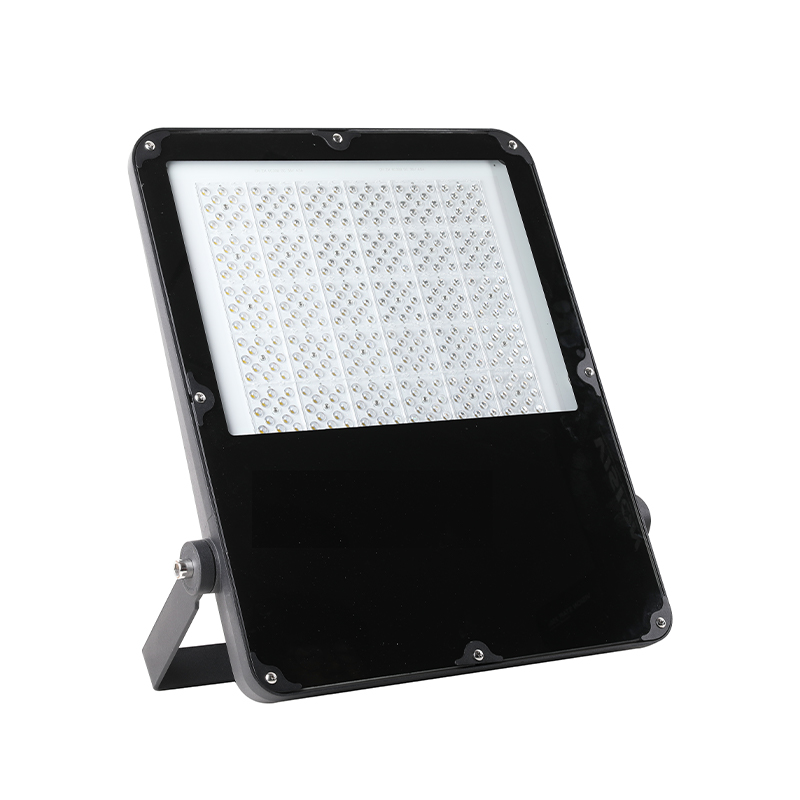
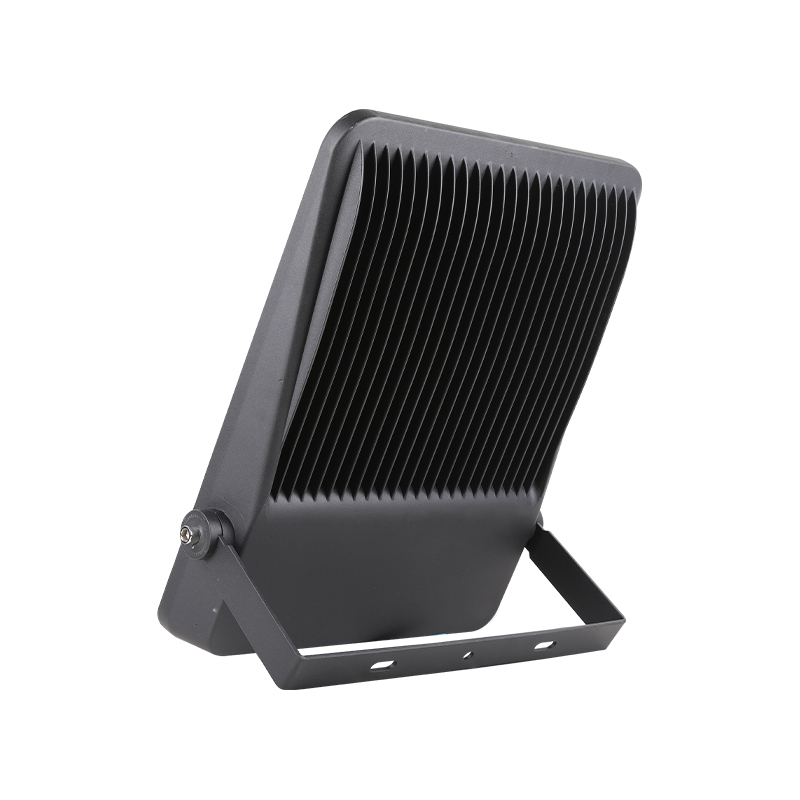 GUARDIAN Series LED Flood Light with IP66 and IK08 ProtectionThis flood light meets the IP66 and IK08 minimum for exposed outdoor use, and its die-cast aluminum heat sink and sealed driver support stable lumen output over long life.View Product →
Heat Dissipation and Driver Life: Hidden Variables Behind 50,000 Hours
Heat sink design and driver quality, not the LED package alone, decide whether a flood light still emits 90 percent of its initial lumens after 50,000 hours. A cast-aluminum heat sink with adequate fin area keeps junction temperature in range; a sealed driver with thermal protection prevents the most common failure mode.
A driver operating near the top of its rated temperature range can lose 30 to 50 percent of its expected life. Specify a driver rated for the highest summer ambient temperature at the installation site.
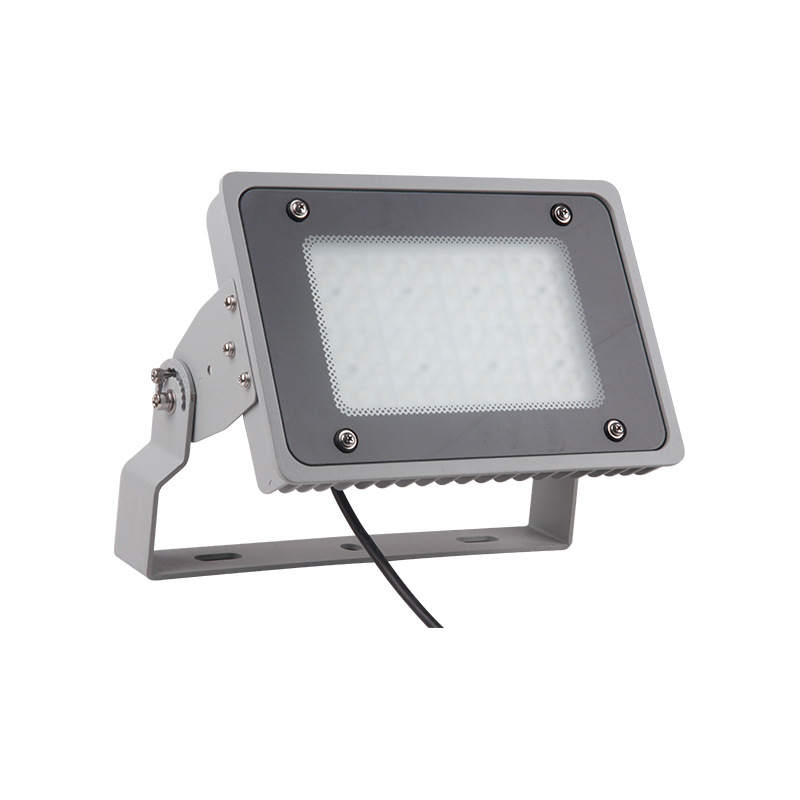
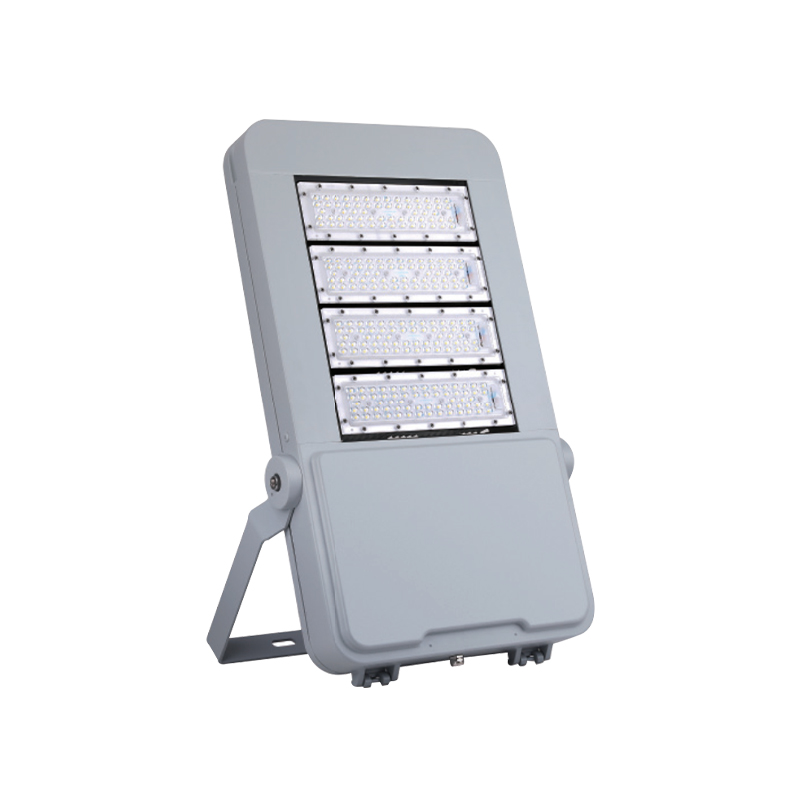 NOVA FLOOD Series Modular LED Flood Light with Tool-Free MaintenanceA modular LED flood light that allows easy gear compartment access and engine replacement, reducing downtime and adapting to future upgrades while cutting energy use compared to older fixtures.View Product →
Wattage and Energy Savings: What Is the Payback for LED Flood Lights?
Replacing a 400 W metal halide flood light with a 150 W LED flood light typically cuts power draw by more than 60 percent and recovers the fixture investment within one to three years, depending on electricity prices and operating hours.
The calculation behind that figure: a 400 W metal halide system draws about 450 W with ballast losses. A 150 W electronic-driver LED fixture draws 150 W. At 12 hours per day and 365 days per year, the difference is 1,314 kWh per fixture per year, worth $158 at $0.12/kWh.
For a project with 50 fixtures, that is roughly $7,900 in annual savings before maintenance. Energy-saving LED flood lights also reduce relamping labor and provide instant restrike after power interruptions.
Before upgrading, verify the existing lux level and pole grid. A 150 W fixture with high efficacy is not an upgrade if its beam angle leaves dark bands between poles.
How to Choose an LED Flood Light for Outdoor Areas: Site by Site
Each outdoor zone has one dominant selection driver: security zones demand uniformity, facades demand beam control, and coastal sites demand corrosion protection. Start with the application, then filter fixtures by the specifications already discussed.
If coastal salt fog is part of the environment, add marine-grade coating and salt-spray test reports to the procurement checklist. Aluminum die-cast housings without proper anodizing will pit within two years.
Security and perimeter lighting
Use a wide symmetric beam of 90-120 degrees, IP66, IK08 or IK10, and a driver compatible with motion sensors or photocell controls.
Facade and architectural lighting
Use a narrow or asymmetric beam of 30-60 degrees, optional high-CRI modules, and internal glare shielding to light the wall without spilling into windows.
For tunnels or underpasses, choose a tunnel-specific photometric profile with controlled uplight; a standard flood light beam creates high luminance contrast and glare for drivers.
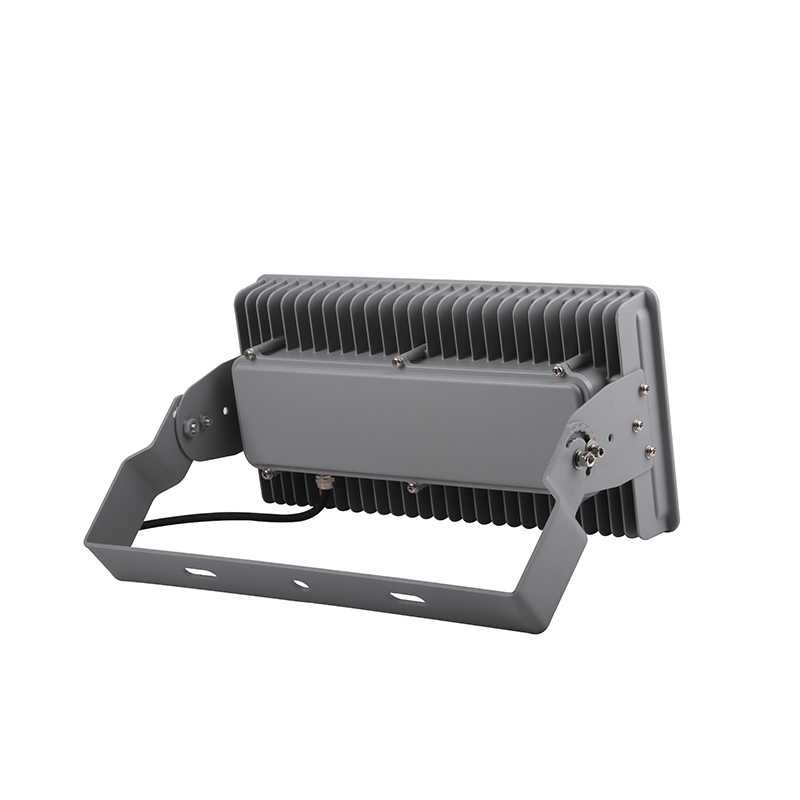 IP66 IK08 30w-120w SPARK Series LED Tunnel LightSPARK offers three sizes to meet the needs of different projects, thus improving flexibility and cost-effectiveness. This design is not only suitable for small project...View Product →
Installation Guide: Common Mistakes That Shorten Flood Light Life
Most early failures come from installation conditions, not from the LED module. Missing surge protection, blocked heat paths, and poorly sealed cable entries account for the majority of warranty returns.
Verify power quality and surge protection. Install a Type 2 SPD when the fixture is fed from overhead lines or a long cable run.
Check mounting orientation. Aim the beam from the photometric plan; a 10-degree error at 10 m moves the light pool by almost 2 m.
Seal cable entries. Use waterproof glands or IP-rated junction boxes; unfinished conduit threads are a common water intrusion path.
Set control schedule and grounding. Confirm the ground connection, then schedule photocell or timer operation before final inspection.
Record baseline temperature. Measure driver housing temperature with an IR thermometer; a 10-15 C rise later indicates a cooling or driver problem.
Preventive maintenance pays: a quarterly visual check of lenses, gaskets, and mounting bolts costs minutes per fixture, while ignored condensation destroys optics and drivers.
Frequently Asked Questions
What wattage LED flood light do I need for a parking lot?
For pole-mounted parking lot lighting at 6-10 m, plan on 60-150 W per fixture depending on area size and target lux. A 30 m by 30 m lot with six poles at 10 m typically works with 100-150 W fixtures at 4000-5000 K.
What is the difference between IP65 and IP66?
IP65 withstands low-pressure water jets, while IP66 withstands powerful jets from any direction. For open poles, roof edges, and regular hose-down cleaning, specify IP66; for sheltered positions, IP65 is often sufficient.
How long do outdoor LED flood lights last?
Quality fixtures carry a 50,000-hour L90 rating at 25 C, which equals 11-12 years at 12 hours per night. LED drivers may need replacement within that period, so choose drivers with thermal protection.
Can LED flood lights be used in coastal or high-humidity areas?
Yes, but only with IP66 sealing, marine-grade coating, and verified salt-spray test data. Aluminum housings without proper anodizing can pit quickly when exposed to sea salt.


 Add.: Jiepai Town, Danyang City, Jiangsu Province, China.
 Tel: +86-0510-86219899
 Phone: +86-18601236320
 Email:
