 +86-0510-86219899


 English
 English
 русский
 Español


Content
- 1 Choose an LED Flood Light for Industrial Yard Use: Start With a Lux Target
- 2 IP, IK and Housing: What an LED Flood Light for Industrial Yard Applications Must Survive
- 3 Beam Angle and Pole Spacing Complete the LED Flood Light for Industrial Yard Layout
- 4 Compare Yard Flood Lights on Measured Performance, Not Wattage
- 5 Energy Cost and Payback: Modernize Your Yard Flood Light Investment
- 6 Frequently Asked Questions About Industrial Yard LED Flood Lights
A yard lighting specification is not a light fixture specification. A 400 W LED flood light mounted at 10 m on a steel pole will not necessarily deliver the lux value printed on its datasheet. Beam angle, mounting height, pole spacing and aiming all change the outcome. Jiangsu Dingrui Lighting Technology Co., Ltd., a manufacturer exporting industrial LED lighting to more than 35 countries, sees the same mistake repeated in project inquiries: buyers select wattage first and then add extra fixtures to close dark zones. This guide reverses that process. Start from the target lux level, then work through beam distribution, impact resistance, layout spacing and payback math, so the LED flood light for industrial yard applications is chosen on numbers that predict performance on asphalt, gravel and concrete.
Choose an LED Flood Light for Industrial Yard Use: Start With a Lux Target
Choose the illuminance target for every yard zone before you look at fixtures; the wattage decision follows from that number. European standard EN 12464-2 sets 20 lux for general circulation in outdoor yards and 100 lux for loading and unloading operations. A parking-only yard needs less than a container handling zone, so write a target for each area before ordering anything.
Uniformity matters as much as the average value. The eye adapts to a bright pool under the pole and perceives the gap between two beams as darkness. EN 12464-2 recommends a uniformity ratio Emin/Eavg of at least 0.25 for low-traffic zones and 0.40 for areas where people move loads.
| Yard zone | Target illuminance | Uniformity Emin/Eavg |
| General circulation and parking | 20 lux | 0.25 |
| Container and storage handling | 50 lux | 0.25 |
| Loading and unloading bays | 100 lux | 0.40 |
| Entrance and security gates | 50-100 lux | 0.40 |
These values are maintained illuminance, measured after dust accumulates and near the end of rated life. An LED fixture running at 90 percent lumen maintenance after 50,000 hours holds its target far longer than a metal halide source that drops to roughly half its initial lumens before the 12,000-hour replacement point.
The sequence that works on real projects: map the yard, fix lux targets per zone, select beam optics, count pole positions, calculate fixture wattage, then confirm IP, IK and surge rating.
IP, IK and Housing: What an LED Flood Light for Industrial Yard Applications Must Survive
The minimum specification for a yard-mounted LED flood light is IP66 ingress protection and IK08 impact resistance. IP66 means the housing is dust-tight and withstands powerful water jets, which is essential because industrial yards are cleaned with pressure washers and host daily dust loads from trucks and bulk material. IK08 means the unit absorbs up to 5 joules of impact energy, enough to survive contact with a forklift mast, a ladder or a dropped pallet.
The housing itself should be die-cast aluminum with exposed cooling fins. Passive thermal design keeps the LED junction temperature under control even on summer afternoons when the enclosure soaks up solar heat, and that temperature defines how many lumens remain after 50,000 hours.
- IP66: dust-tight and protected against powerful water jets
- IK08: withstands 5 J impacts for routine yard contact
- Finned aluminum body sized for ambient temperatures up to 50 degrees C
- Built-in surge protection of at least 10 kV for overhead line runs
- Adjustable bracket for aiming after the pole is installed
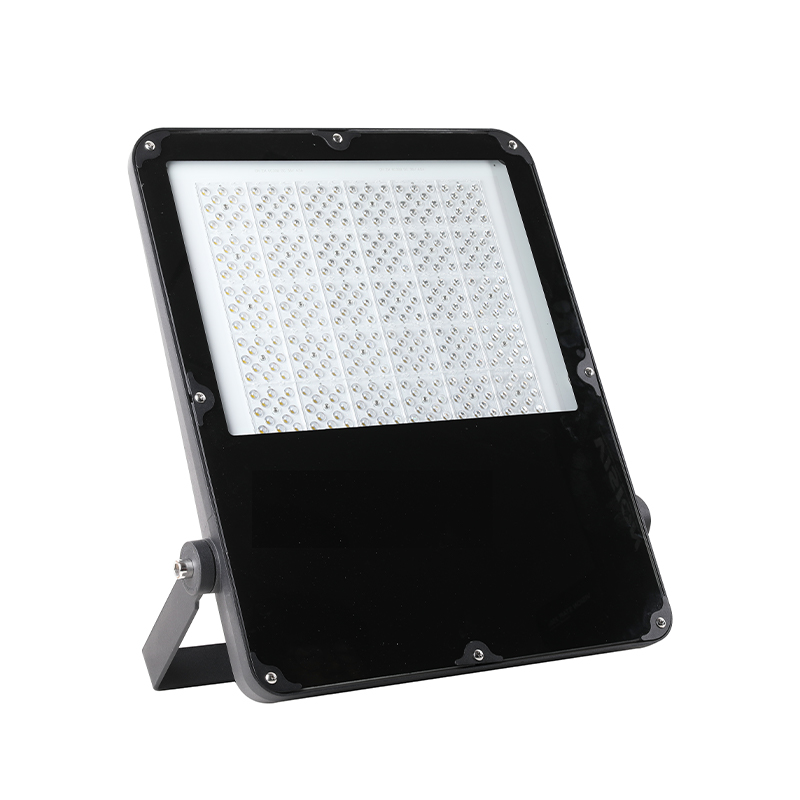
Below 8 m mounting height, a 100-200 W unit usually suffices; above 12 m, plan for 300-400 W. One ready-made specification is Dingrui's Guardian series, a 60-400 W outdoor LED flood light rated IP66 and IK08, built for this type of site.
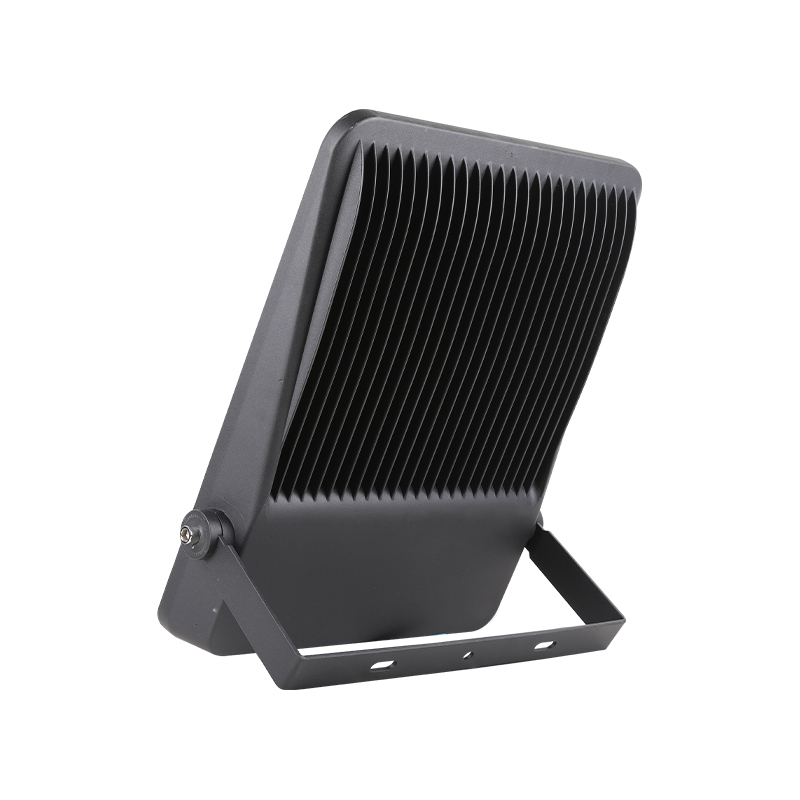 Dingrui Guardian Series LED Flood Light, 60-400 W, IP66 IK08This industrial flood light is rated IP66 and IK08, suits mounting heights from 8 to 12 meters, and offers interchangeable lenses and easy maintenance for robust outdoor sites.View Product →
Beam Angle and Pole Spacing Complete the LED Flood Light for Industrial Yard Layout
Beam angle does more work than wattage in a yard layout. A 300 W flood light with a 60-degree beam concentrates flux into a narrow pool at the base of the pole, producing high lux directly underneath and almost nothing 25 m away. For 8-12 m mounting heights, use a medium distribution between 60 and 90 degrees, and keep pole spacing within three to four times the mounting height.
Calculate fixture count with N = (E x A) / (Phi x UF x MF), where E is target lux, A is area in square meters, Phi is initial system lumens, UF is utilization factor and MF is maintenance factor. In an open yard, UF typically sits between 0.6 and 0.7; MF for LED ranges from 0.7 to 0.8 depending on the cleaning schedule.
A 40 x 60 m yard is 2,400 square meters. At 50 lux with 45,000-lumen fixtures, N = (50 x 2400) / (45,000 x 0.65 x 0.75) = 5.5, so specify six fixtures. At 20 lux for simple parking, three fixtures with a wider distribution cover the same area.
System efficacy comparison, lumens per watt
Spacing rule of thumb: for every meter of mounting height, allow up to 3.5 m between poles with a medium beam; tightening to 3.0 m improves uniformity at the cost of extra fixtures.
Compare Yard Flood Lights on Measured Performance, Not Wattage
Two flood lights with the same wattage can differ by 30 percent or more in delivered light, so compare system lumens, system efficacy and warranty terms instead. A 400 W metal halide flood light produces roughly 26,000 initial lumens and loses half of that before 12,000 hours. A modern 300 W LED flood light from a volume manufacturer delivers around 45,000 system lumens at 150 lm/W and keeps more than 90 percent of that output at 50,000 hours.
| Parameter | 400 W metal halide | 300 W LED flood light |
| System lumens | 26,000 | 45,000 |
| System efficacy | 65 lm/W | 150 lm/W |
| Rated life | 12,000 h | 50,000 h |
| Lumen maintenance | About 50% at rated life | At least 90% at 50,000 h |
| Ingress / impact rating | IP65 / IK06 | IP66 / IK08 |
| Warranty | 1 year | 5 years |
One LED unit therefore replaces the light output of two metal halide fixtures while drawing less input power. For projects that value serviceability, Dingrui's Nova series offers a 30-300 W modular flood light design in which optical and driver modules can be swapped without discarding the housing.
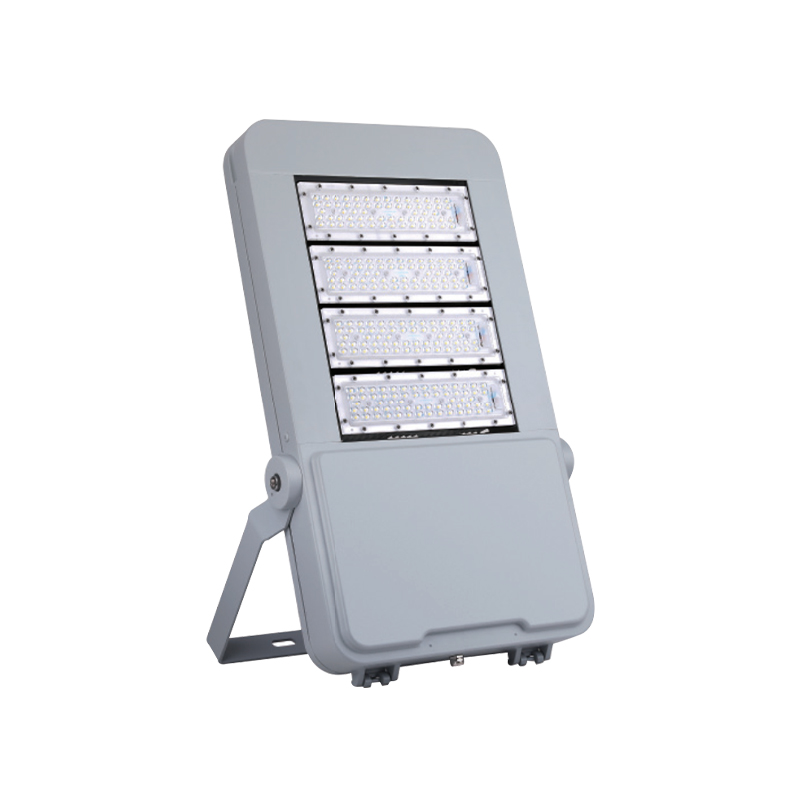 Dingrui Nova Series Modular LED Flood Light, 30-300 WThis tool-free modular flood light lets you swap optical and driver modules without discarding the housing, making it a serviceable replacement for metal halide units in many projects.View Product →
Energy Cost and Payback: Modernize Your Yard Flood Light Investment
Replacing 1,000 W metal halide fixtures with 300 W LED flood lights in a 20-fixture yard cuts yearly energy use by about 65 percent and usually reaches payback before the third year. Twenty fixtures at 1,000 W running 12 hours per night for 365 days consume 87,600 kWh per year. The same 20 fixtures at 300 W consume 26,280 kWh. At an average industrial rate of 0.12 USD per kWh, the energy bill drops from 10,512 USD to 3,154 USD per year, a saving of roughly 7,360 USD annually.
Metal halide yard before
- 87,600 kWh per year for 20 fixtures
- 10,512 USD yearly energy cost
- 12,000 h lamp life, relamps every 2-3 years
- Ra 20-35, poor color and visibility
- Each lamp replacement needs a bucket truck
LED yard after
- 26,280 kWh per year for 20 fixtures
- 3,154 USD yearly energy cost
- 50,000 h rated life, service beyond 10 years
- Ra 70-80, better contrast for drivers
- Module swaps done from a single fixture
Beyond energy, maintenance dominates the old-technology cost. Metal halide output declines continuously, so a two-year-old installation becomes a safety complaint. Energy-saving LED flood lights hold luminous flux within a few percent over the same period, which is why facility teams often upgrade before the old fixtures reach end of life.
A 20-fixture industrial yard at 0.12 USD per kWh: 10,512 USD to 3,154 USD in annual energy cost, with relamping intervals stretching from roughly 2.9 years to beyond 10 years.
Frequently Asked Questions About Industrial Yard LED Flood Lights
What LED flood light wattage is best for an industrial yard?
For 6-9 m mounting heights, 100-200 W per fixture is usually sufficient. At 9-12 m, use 200-300 W; above 12 m, choose 300-400 W. Wattage is secondary to beam angle and pole spacing, which together determine whether light lands where the yard task happens.
How many LED flood lights do I need for a yard area?
Use the formula N = (E x A) / (Phi x UF x MF), where E is target lux, A is area, Phi is system lumens, UF is utilization factor (0.6-0.7) and MF is maintenance factor (0.7-0.8). A 40 x 60 m yard at 50 lux with 45,000-lumen fixtures needs six units.
What is the difference between IP65 and IP66 for outdoor flood lights?
IP65 protects against low-pressure water jets and some dust; IP66 is dust-tight and resists powerful water jets. Yards washed with pressure washers require IP66, and the upgraded seal also slows optical contamination in dusty environments.
Can industrial yard LED flood lights be dimmed to save more energy?
Yes. Quality fixtures support DALI or 0-10 V dimming, and combining dimming with occupancy-based control typically saves another 20-40 percent beyond the LED efficiency gain, because yards rarely need full output when no vehicles are moving.


 Add.: Jiepai Town, Danyang City, Jiangsu Province, China.
 Tel: +86-0510-86219899
 Phone: +86-18601236320
 Email:
