 +86-0510-86219899


 English
 English
 русский
 Español


Content
- 1 Mounting Height Is the First Specification, Not an Afterthought
- 2 Core Specifications for an LED High Bay Light for Warehouse Use
- 3 UFO or Linear: Choosing an LED High Bay Light for Warehouse Layouts
- 4 Estimating Fixture Count Before You Write the Purchase Order
- 5 Energy Cost and Payback: Numbers That Justify the Budget
- 6 Buying Direct from a Manufacturer: What Changes
- 7 Frequently Asked Questions
A 40,000-square-foot distribution center typically runs sixty to eighty high bay fixtures. If those are 400W metal halide units, the lighting load alone draws about 28 kW. At 12 hours per day and the US commercial average of $0.12 per kWh, that load costs more than $28,000 a year before a single lamp replacement enters the budget. Swapping those fixtures for an LED high bay light for warehouse operations is not a cosmetic refresh; it is a photometric and financial decision that shows up in the first month's utility bill.
This guide is written for facility managers, plant engineers, and distributors who need a defensible decision rather than a brochure summary. It covers mounting height, beam distribution, lumen output, driver quality, and payback math, plus how manufacturer-direct procurement changes retrofit economics.
Mounting Height Is the First Specification, Not an Afterthought
Mounting height determines whether a fixture qualifies as a high bay at all, and it dictates every downstream choice: beam angle, lumen package, mounting hardware, and driver type. A fixture that performs well at 8 meters will fail at 14 meters, regardless of its lumen output.
At 6 to 9 meters, a wide 90 to 110 degree beam spreads light evenly across open storage. Above 10 meters, the beam must tighten to 60 to 75 degrees so the light reaches the floor instead of spilling into racking. Warehouse zones differ, so set the specification per zone, not for the building as a whole.
- 6 to 9 m: small distribution centers, workshops, mezzanine storage - 100W class fixtures with wide beams
- 9 to 12 m: typical warehouse floor and pallet racking - 150W class fixtures with medium beams
- 12 to 15 m: tall racking, automated storage aisles, bulk zones - 200W class fixtures with narrow beams
Core Specifications for an LED High Bay Light for Warehouse Use
Compare five numbers before any brand conversation: lumen output, beam angle, color temperature, ingress protection, and driver warranty. These five determine whether the installed system will hit the illuminance target you designed for.
Lumen output is total light emitted; for a warehouse bay, 15,000 to 30,000 lumens per fixture is the practical range. Beam angle controls distribution; 90 degrees suits most layouts, while narrow 60 degree optics fit very tall racking. Color temperature of 4000 to 5000K gives the crisp neutral white that warehouse staff read as daylight. Ingress protection should be at least IP65 in dusty warehouses; impact resistance should be IK08 or better. The driver fails first, so look for an isolated, programmable driver rated for at least five years.
| Fixture Wattage | Typical Lumens | Beam Angle | Mounting Height | Typical Warehouse Zone |
| 100W | 15,000 lm | 90 to 110 deg | 6 to 9 m | Packing lines, bulk storage |
| 150W | 22,000 lm | 80 to 90 deg | 8 to 12 m | Pallet racking, pick areas |
| 200W | 30,000 lm | 60 to 75 deg | 10 to 15 m | Tall racking, open floor |
Before you approve a sample, run this checklist:
- Isolated driver with 0-10V dimming ready
- IP65 or higher ingress protection
- IK08 or higher impact resistance
- Documented lumen maintenance above 90 percent at 50,000 hours
- Five-year warranty with a local support channel
A fixture in the 100 to 200W band, such as the Mira series LED high bay light, covers the most common warehouse heights and simplifies zone planning with shared housing and optics across power steps.
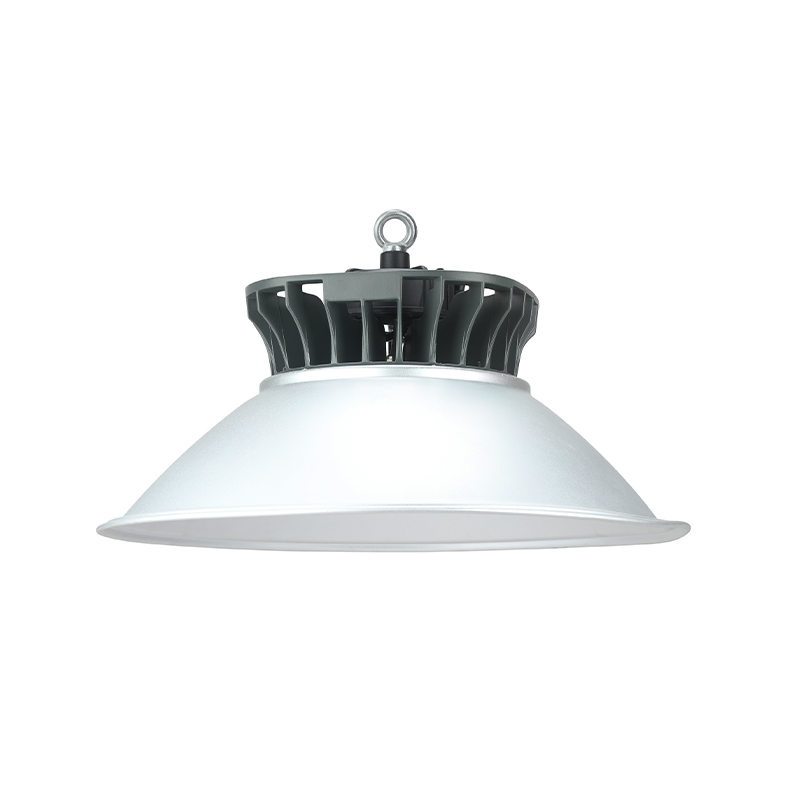 MIRA Series LED High Bay Light for Warehouse ZonesThis 100W-200W high bay light offers hanging or U-bracket mounting options, with die-cast aluminum housing and corrosion-resistant coating. It suits typical warehouse heights and supports consistent zone planning.View Product →
UFO or Linear: Choosing an LED High Bay Light for Warehouse Layouts
Fixture shape should follow aisle geometry. UFO fixtures suit symmetric open areas; linear fixtures suit long, narrow racking lanes. The distinction is photometric, not cosmetic.
UFO High Bay
- Compact round housing with a symmetric beam
- Single optical chamber, easy to aim and mount
- Best for open floor, bulk storage, cross-dock zones
- Lightweight, simple hook or pendant installation
Linear High Bay
- Elongated housing with a linear optic
- Beam spreads along the aisle, not across it
- Best for selective pallet racking and narrow aisles
- More even vertical illuminance on rack faces
For suspended layouts, do not improvise the mounting. A fixture with engineered suspension hardware, such as the Toro series suspension-mount LED high bay light, keeps the housing level, prevents vibration, and shortens installation time.
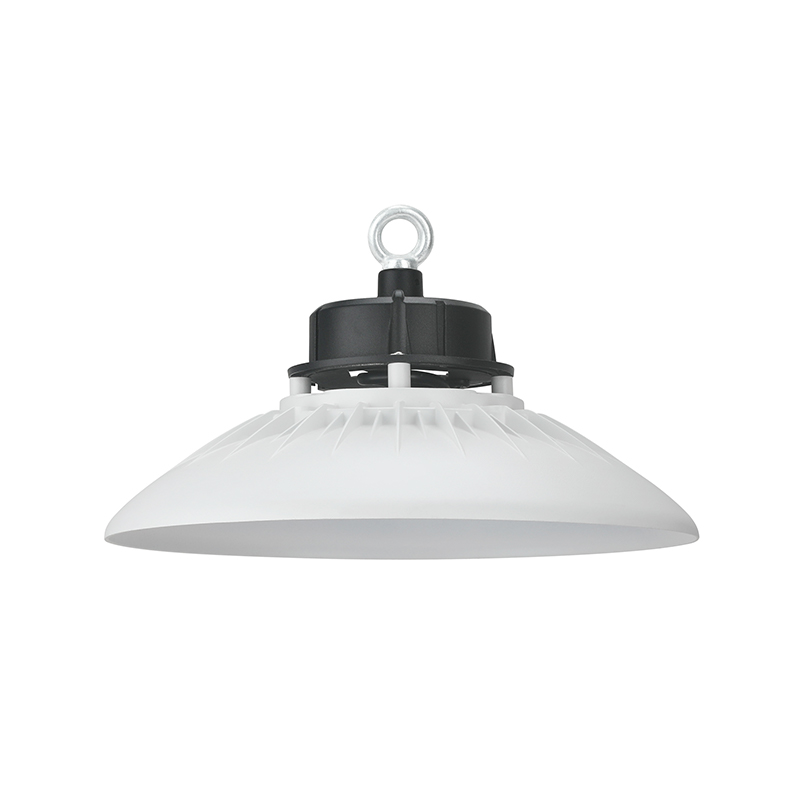 TORO Series LED High Bay Light with Suspension MountingDesigned with engineered suspension hardware, this fixture simplifies installation, maintains level alignment, and resists vibration. Its modular structure eases maintenance, while the durable aluminum body suits demanding environments.View Product →
Estimating Fixture Count Before You Write the Purchase Order
Work from target lux, not from wattage. The standard design equation is: fixture count = (target lux x floor area) / (lumens per fixture x utilization factor x maintenance factor).
Utilization factor (0.6 to 0.8) covers room geometry and surface reflectance; maintenance factor (0.7 typical) covers lumen depreciation and dirt. Together they cut the raw lumen figure by roughly half - skipping them is why many warehouses come out darker than planned.
Example: a 4,000 square meter warehouse at 200 lux with 22,000 lumen fixtures, utilization 0.7 and maintenance 0.7 needs about 75 fixtures: (200 x 4000) divided by (22,000 x 0.7 x 0.7). A 400W metal halide layout draws almost twice the power for the same count.
Energy Cost and Payback: Numbers That Justify the Budget
Replacing a 400W metal halide with a 150 to 200W LED high bay cuts lighting energy draw by at least half while holding working-plane lux at or above the old level. The chart below compares annual energy cost per fixture for the three most common retrofit paths.
The gap widens with maintenance. Metal halide lamps fail at 10,000 to 15,000 hours; an LED high bay is rated for 50,000 hours or more. At 12 hours a day, expect a lamp change every two to three years per metal halide fixture versus a full decade of LED service. For more on luminous efficacy and fixture comparison, see our analysis of key efficiency metrics for LED luminaires.
Buying Direct from a Manufacturer: What Changes
Buying LED high bay fixtures directly from a manufacturer removes the distributor margin, but it places more responsibility on your specification. The trade-off is worth it when the supplier has engineering depth and a documented quality system.
Jiangsu Dingrui Lighting Technology Co., Ltd. fits this model: 15 years in LED lighting, more than 20 patents, and exports to over 35 countries. Ask four questions when buying direct: which certifications the fixture carries (CE, RoHS, ISO 9001, UL); whether the factory can adjust optics, drivers, or mounting hardware; sample and production lead times; and the warranty process for field failures.
- CE and RoHS for European projects
- ISO 9001 for production quality systems
- UL for North American installations
- IP66 and IK08 or higher for environment and impact protection
When you purchase from an industrial LED lighting manufacturer directly, the spec sheet becomes the contract, so verify every number: photometric reports, driver datasheets, and warranty terms.
Frequently Asked Questions
How many lumens do I need for a warehouse high bay fixture?
For an 8 to 10 meter mounting height, 18,000 to 25,000 lumens per fixture delivers roughly 200 lux with a typical layout. Bulk storage runs with 15,000 lumens; precision picking and inspection zones should plan for 30,000 or more.
What is the difference between UFO and linear high bay lights?
A UFO high bay emits a round, symmetric beam from a compact housing and works best on open floor areas. A linear high bay emits an elongated beam that follows racking aisles, so vertical illuminance on rack faces is more even. Choose by aisle geometry, not appearance.
Can LED high bay lights be dimmed or paired with motion sensors?
Yes. Most commercial-grade drivers support 0-10V dimming, and occupancy or daylight sensors can be integrated into the fixture or mounted separately. In intermittent-use zones, sensor control typically saves 30 to 50 percent of lighting energy.
What is the typical payback period when replacing metal halide with LED high bay lights?
At 12 hours per day and $0.12 per kWh, a 200W LED replacing a 400W metal halide saves about $105 per fixture per year. With manufacturer-direct pricing, payback lands between 12 and 18 months; at 24-hour operation it can drop below 8 months.


 Add.: Jiepai Town, Danyang City, Jiangsu Province, China.
 Tel: +86-0510-86219899
 Phone: +86-18601236320
 Email:
