 +86-0510-86219899

 English
 English
 русский
 Español

Content
- 1 What Does a 160lm/W LED Street Light Rating Mean?
- 2 Why High-Efficacy Street Lights Shorten Road Project Payback
- 3 How to Verify a 160lm/W LED Street Light Before You Order
- 4 Matching High-Efficacy Street Lights to Road Class and Height
- 5 Real-World Factors That Make or Break the Rating
- 6 160lm/W LED Street Light FAQ
A 2,400-fixture road lighting tender in Southeast Asia recently shortlisted suppliers on a single metric: measured system efficacy. Contractors who could document a 160lm/W LED street light at the photometric bench passed the first round; those who could only quote chip-level numbers were cut immediately. That is the new reality of municipal lighting procurement.
For a manufacturer such as Jiangsu Dingrui Lighting Technology Co., Ltd., the 160lm/W LED street light mark is not marketing language. It is a design target that shapes driver selection, optical design, thermal management, and even the grade of aluminum in the housing. For buyers, the same number decides connected load, cable sizing, energy budgets, and the payback period on every pole in a district.
This guide explains what 160lm/W means at the luminaire level, why it reshapes project economics, and how to verify the rating before you release a purchase order.
What Does a 160lm/W LED Street Light Rating Mean?
A 160lm/W LED street light rating means the complete luminaire, including LED chips, driver losses, optical absorption, and thermal derating, produces 160 lumens of usable light for every watt drawn from the mains. It is a system-level number, and it is always lower than the bare-chip efficacy printed on LED data sheets.
A high-performance 3030 or 5050 SMD chip can reach 200-220lm/W at 25 degree C in laboratory conditions. Inside a real luminaire, the driver converts AC power at 92-95 percent efficiency, the optical lens or reflector absorbs 6-12 percent of the flux, and junction temperature pulls another few percent. Together, those losses separate chip claims from delivered performance by 10-20 percent. That is why LM-79 photometric reports, not LED bin cards, are the reference documents for a 160lm/W specification.
System efficacy (lm/W) equals the total luminous flux of a luminaire divided by the input power measured at the mains. It is the only honest basis for comparing street lights, because it includes every loss between the grid and the road surface.
Why High-Efficacy Street Lights Shorten Road Project Payback
Specifying a 160lm/W LED street light instead of a 110lm/W unit cuts connected load by roughly 30 percent at equal maintained illuminance, and it shortens typical municipal payback by one to two years.
Run the numbers on a standard replacement. A 250W high-pressure sodium luminaire draws about 285W from the mains once ballast losses are included and delivers roughly 25,000 lm from the complete fitting. A 150W LED at 110lm/W produces about 16,500 lm, which is enough to replace that HPS fixture because optical control is tighter and the maintenance factor is higher. A 103W LED at 160lm/W produces the same 16,500 lm with 31 percent less power than the 150W unit.
For a 1,000-fixture corridor, moving from 110lm/W to 160lm/W removes roughly 206,000 kWh from the annual energy bill, which is enough to power more than 25 average households, and it cuts carbon accounting by about 90 tonnes of CO2 per year at a 0.4 kg/kWh grid factor.
| Parameter | 250W HPS | 150W LED (110lm/W) | 103W LED (160lm/W) |
| System input power | 285 W | 150 W | 103 W |
| Annual energy (12 h x 365 nights) | 1,248 kWh | 657 kWh | 451 kWh |
| Annual energy cost at $0.12/kWh | $150 | $79 | $54 |
| CO2 per year at 0.4 kg/kWh | 499 kg | 263 kg | 180 kg |
| Typical relamping interval | 2-4 years | 10+ years | 10+ years |
- Relamping and optical cleaning every 2-4 years
- Dimming requires extra control gear
- Warm 2100K color weakens CCTV images
- Most input energy becomes heat in the fitting
- No relamping for 10+ years
- 0-10V or DALI dimming is standard
- 3000-4000K CCT supports camera recognition
- Most input energy leaves the fixture as light
How to Verify a 160lm/W LED Street Light Before You Order
Verification starts with an LM-79 photometric report for the exact model you are buying, measured at 25 degree C ambient, and ideally re-checked at the operating temperature to expose thermal derating.
In our experience auditing supplier documentation for municipal projects, the most common failure is not the LED chip. It is the gap between the chip claim and the luminaire measurement. Ask for the following documents and confirm they name the actual model number, driver, and LED configuration you intend to purchase.
- An LM-79 report from an accredited laboratory for the fixture model, not a similar family unit
- LM-80 chip data combined with a TM-21 projection for L90 lumen maintenance
- Input power in watts measured at the fixture, within plus or minus 5 percent of the declared value
- An IES or EULUMDAT photometric file showing Type II or Type III distribution and upward light below 3 percent
- The driver brand, surge protection rating, and driver efficiency, because a 94 percent driver adds roughly 2 lm/W over an 89 percent driver
On the manufacturer side, the Atlantic Lite series is specified at 120-180lm/W measured system efficacy, and the supporting photometric documents are presented before order, not after.
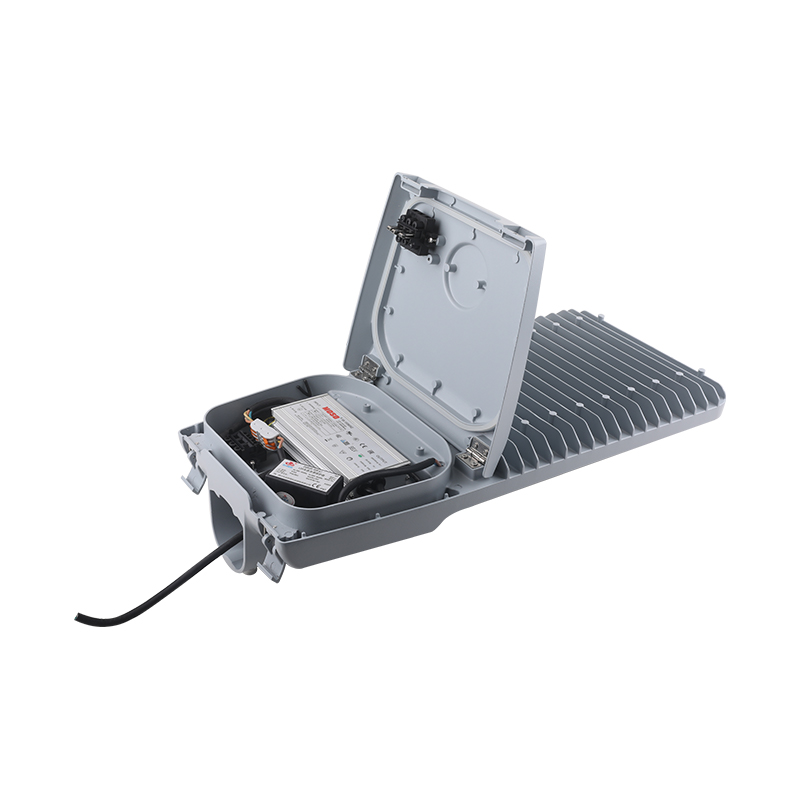 Atlantic Lite Series LED Street Light with 120-180 lm/W EfficacyThis street light offers 50W to 200W options with system efficacy up to 180 lm/W, helping reduce wattage selection for a given road class. Photometric documents are available before ordering.View Product →
Matching High-Efficacy Street Lights to Road Class and Height
For a given road class, a 160lm/W LED street light moves the wattage selection down one full bracket compared with a 110lm/W fixture, for example 80W instead of 110W at an 11 m mounting height, without sacrificing illuminance or uniformity.
The final choice depends on road width, lane count, pole spacing, and the lighting class in your local standard. The table below gives practical starting points for a Type II or Type III distribution with a maintenance factor of 0.8.
| Road class | Mounting height | Wattage at 160lm/W | Luminaire lumens |
| M5 (local access) | 6-8 m | 30-40 W | 4,800-6,400 lm |
| M4 (collector) | 8-9 m | 50-70 W | 8,000-11,200 lm |
| M3 (minor arterial) | 9-10 m | 70-90 W | 11,200-14,400 lm |
| M2 (arterial) | 10-12 m | 90-120 W | 14,400-19,200 lm |
| M1 (major arterial) | 12-14 m | 120-180 W | 19,200-28,800 lm |
Class is only half the decision. Glare rating (U0), surround ratio, and longitudinal uniformity on wet asphalt often force an optical change even when the lumen count looks correct. Specify Type III optics for wide carriageways and Type II optics for narrow roads so the light stays on the pavement.
If your site does not fit these brackets, check the photometric files published with our complete street light range.
For heavy main-road installations in the 60-400W range, the Venus series provides the same high-efficacy approach in a heavy-duty housing with a D60mm mounting arm.
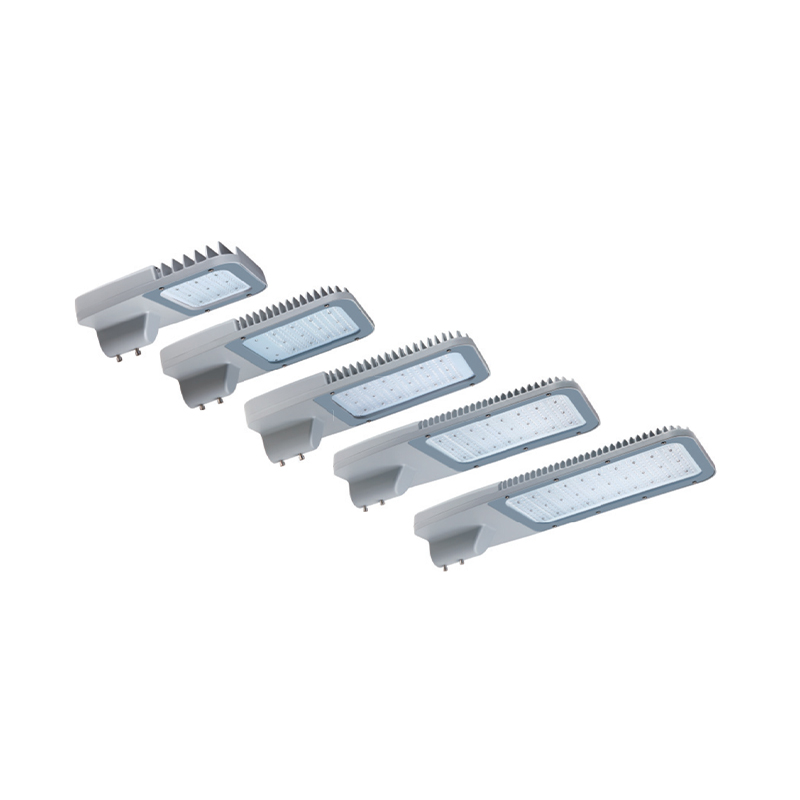 Venus Series Heavy Duty LED Street Light for 60-400W ApplicationsDesigned for main-road installations, this fixture uses a D60mm mounting arm and heavy-duty housing. Tool-free access to the gear compartment simplifies maintenance while optical lenses ensure uniform, glare-reduced light.View Product →
Real-World Factors That Make or Break the Rating
Field performance lags laboratory numbers when thermal management, optical control, and driver quality are not engineered as one system. A poorly designed reflector alone can erase 10-15 percent of the efficacy advantage.
- Thermal: junction temperature at 85 degree C versus 105 degree C can halve L90 lifetime; request the TMP value on the LM-80 report and check it against your hottest month
- Optics: glass lenses and vacuum-aluminized reflectors hold 90 percent efficiency without yellowing; polycarbonate optics lose transmittance under UV over several years
- Driver: a 92-95 percent efficiency driver with 10kV surge protection matters more than a marginal LED bin upgrade on a highway
- Sealing: IP66-tested housings keep out sand, salt, and humidity; IK09-IK10 impact resistance protects against roadside damage and vandalism
For projects where impact resistance and modular maintenance are priorities, the Nova series combines IP66 and IK10 with module-level replaceability, so the optics can be serviced without replacing the whole housing.
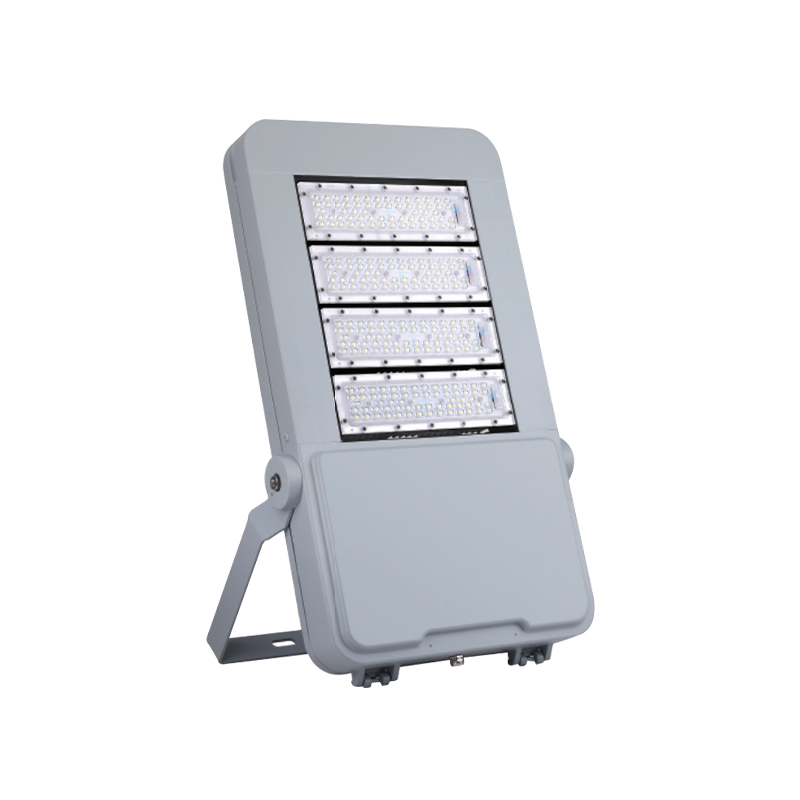 Nova Series Modular LED Street Light with IP66 and IK10 ProtectionThis modular luminaire supports 30W to 300W with one to six LED modules, allowing flexible light output and easy replacement. Its tool-free gear compartment and sturdy die-cast aluminum body suit demanding environments.View Product →
160lm/W LED Street Light FAQ
Is 160lm/W realistic for a complete LED street light fixture?
Yes. Premium fixtures with 5050 SMD chips, a 94 percent driver, glass optics, and sound thermal design measure 155-165lm/W on LM-79 reports. Values above 170lm/W at the complete-fixture level are rare and justify extra verification.
What wattage do I need for a 12 m mounting height?
For M2 arterial roads, start at 100-120W at 160lm/W (14,400-19,200 lm). For M1 roads, use 120-180W (19,200-28,800 lm). Final selection requires a simulation with your actual pole spacing and road width.
What is the difference between chip efficacy and system efficacy?
Chip efficacy is a bare LED measured at 25 degree C in a laboratory. System efficacy includes driver losses, optical absorption, and thermal effects, and it is 10-20 percent lower. System efficacy is the number that determines your energy bill.
Will a 160lm/W street light hold its rating in hot climates?
Expect a derating of 5-10 percent when ambient temperature reaches 50-55 degree C. Request the LM-80 and TM-21 reports with the TMP value, and select the fixture so the junction stays below that limit in the hottest month.



 Add.: Jiepai Town, Danyang City, Jiangsu Province, China.
 Tel: +86-0510-86219899
 Phone: +86-18601236320
 Email: